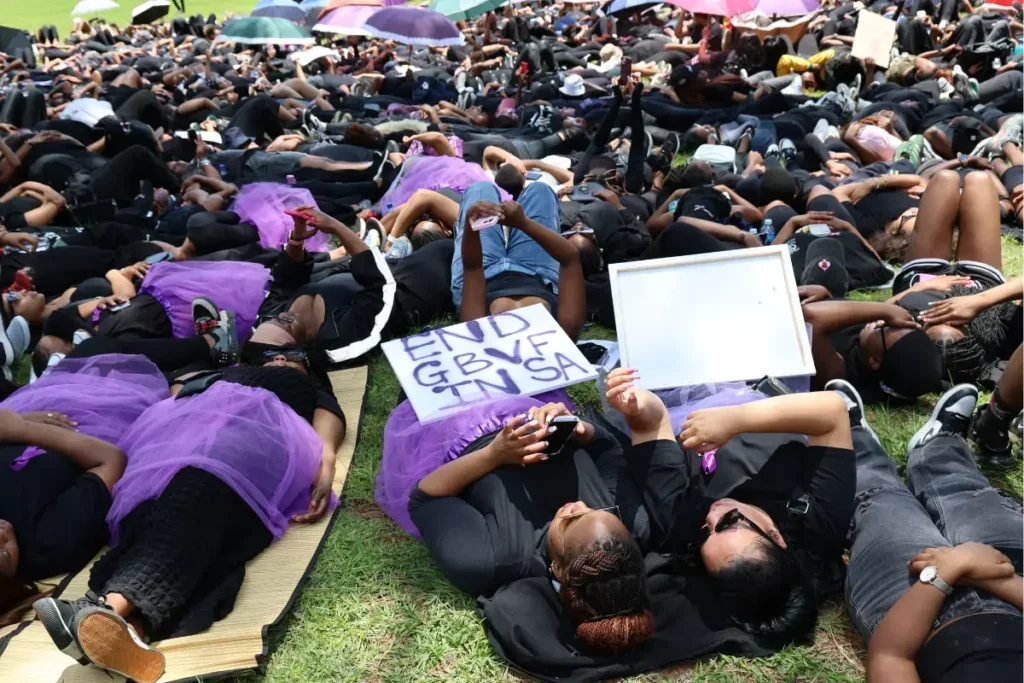
On the eve of the first G20 Summit held on African soil, South African women staged one of the country’s most striking civic mobilisations in recent history. Across Johannesburg, Cape Town, Durban, Pretoria and Gqeberha, thousands dressed in black lay down in silence for fifteen minutes, each minute honouring one of the women lost every day to gender-based violence (GBV) in South Africa.
Coordinated by the movement Women For Change, the G20 Women’s Shutdown asked women and LGBTQ+ communities to step back from paid labour, unpaid domestic work and daily consumption. The intention was both symbolic and economic: to expose the invisible labour that sustains the country and to underline the profound imbalance between women’s contributions to society and the dangers they face.
Over a month of mobilisation, the movement gathered more than one million signatures and pushed the National Disaster Management Centre to declare GBV and femicide a national disaster. This designation, typically reserved for large-scale natural or public-health emergencies, signalled a recognition of the scale of the crisis. By securing this declaration as global leaders arrived for the G20, South African women made it clear that the country’s development agenda cannot be separated from the reality of widespread violence
The urgency is reflected in the data. A recent national femicide study by the South African Medical Research Council found that between 2020 and 2021, 5.5 women per 100,000 were killed by intimate partners, a rate the authors note is almost five times higher than the latest global average for intimate partner and family-related femicide. Earlier mortuary-based surveys show that although femicide rates have declined since 1999, South Africa still records one of the highest levels of intimate partner femicide in the world. A previous national study estimated that nearly half of all women killed violently in the country die at the hands of an intimate partner, underscoring the persistent lethality of domestic settings. Recent gender-based violence surveys also report widespread non-lethal abuse: one nationally representative study found that about 22 percent of women had experienced physical violence from a partner in their lifetime, and around 8 percent had experienced sexual violence from a partner. Taken together, these findings confirm that GBV is not a marginal social issue but a structural constraint on South Africa’s development, damaging health, eroding human capital and undermining long-term economic stability.
The disaster declaration creates an opening for a more coordinated and adequately funded national response, including specialised courts, expanded shelters and improved survivor services. Its effectiveness will depend on political will, implementation and public accountability. What has shifted is the framing: GBV is no longer treated as a social issue confined to gender ministries, but as a systemic risk that affects the country’s social and economic future.
The implications extend across Africa, where violence against women is a daily reality that often remains undocumented and unaddressed. In many countries, GBV is embedded in social norms and becomes even more severe in periods of conflict, political instability or displacement, where rape is routinely used as a weapon of war. South Africa’s decision to elevate GBV to the level of a national disaster therefore offers more than a domestic policy shift; it provides a blueprint for the continent. It shows that African governments can treat violence against women as a matter of national security, development and governance, and that organised, evidence-driven civic action can compel states to confront crises that women have long carried alone. The G20 Women’s Shutdown revealed that when personal testimonies, data and public mobilisation converge, entrenched systems can be forced to respond, a lesson with profound relevance for countries facing chronic GBV, fragile institutions or ongoing conflict.
Yet the risk remains that momentum fades once the G20 leaves the headlines. Sustained progress requires confronting the core of the problem: the men and the wider ecosystem that perpetrate and enable violence. South Africa needs a justice system that prosecutes offenders swiftly and consistently, with penalties strong enough to deter future attacks. Prevention must be strengthened through education on consent and gender equality, as well as through community programmes that challenge the norms that normalise violence. Alongside adequate funding and stronger accountability across policing and courts, real change will depend on a society that holds perpetrators responsible rather than expecting women to endure and adapt.
A quiet political threshold has been crossed. South African women have forced leaders to confront a truth that echoes across the continent: no society can speak credibly about development, stability or progress while its women live under constant threat. For Africa, the message is unmistakable. Ending gender-based violence is not an adjunct to development; it is a fundamental human right and a prerequisite for the continent’s resilience, stability and long-term prosperity.
Sources
- AfricanPact. (2023, June 21). The silent crisis: Exposing the tragic effects of learning poverty in Africa. AfricanPact. https://africanpact.org/2023/06/21/the-silent-crisis-exposing-the-tragic-effects-of-learning-poverty-education-in-africa/
- Abrahams, N., Mathews, S., Martin, L. J., Lombard, C., & Jewkes, R. (2025). Two decades of tracking femicide in South Africa: An analysis of four national surveys from 1999 to 2020/21. PLOS Medicine. https://pubmed.ncbi.nlm.nih.gov/41243236/
- Human Sciences Research Council. (2024). Violence against women in South Africa: Intersecting vulnerabilities. HSRC. https://hsrc.ac.za/
- KPMG South Africa. (2014). Too costly to ignore: The economic impact of gender-based violence in South Africa. KPMG South Africa.
- Mathews, S., Abrahams, N., Jewkes, R., Martin, L. J., & Lombard, C. (2009). Intimate femicide-suicide in South Africa: A national cross-sectional study. South African Medical Journal.
- Mathews, S., Abrahams, N., Martin, L. J., & Jewkes, R. (2008). Femicide in South Africa. In South African Health Review 2008 (pp. 103–112). Health Systems Trust.
- Mkwananzi, S. (2024). Gender-based violence in South Africa: Prevalence and predictors. Journal of Interpersonal Violence. https://pmc.ncbi.nlm.nih.gov/articles/PMC11303172/
- UNODC & UN Women. (2023). Femicides in 2023: Global estimates of intimate partner and family-related killing of women and girls. United Nations.
- UN Women. (2024, November 22). Tackling femicide in South Africa through laws, policies and better policing. https://www.unwomen.org/
- Women For Change. (2025). About us. https://womenforchange.co.za/about-us/