The Lobito Corridor entered a new development phase in late 2025 with the securing of a USD 753 million financing package, including a USD 553 million loan from the U.S. International Development Finance Corporation and USD 200 million from the Development Bank of Southern Africa. The funding supports the rehabilitation of approximately 1,300 kilometres of rail infrastructure in Angola, linking the mineral terminal at the Port of Lobito to Luau near the border with the Democratic Republic of the Congo, alongside capacity expansion along the corridor.
Beyond its scale, the timing of this financing reflects broader shifts in how international actors engage with African infrastructure. Traditional bilateral aid has gradually given way to development finance institutions deploying long-term capital into commercially structured projects, particularly where infrastructure underpins trade, mineral logistics, and export competitiveness. The Lobito Corridor sits squarely within this evolution.
What’s the Lobito Corridor?
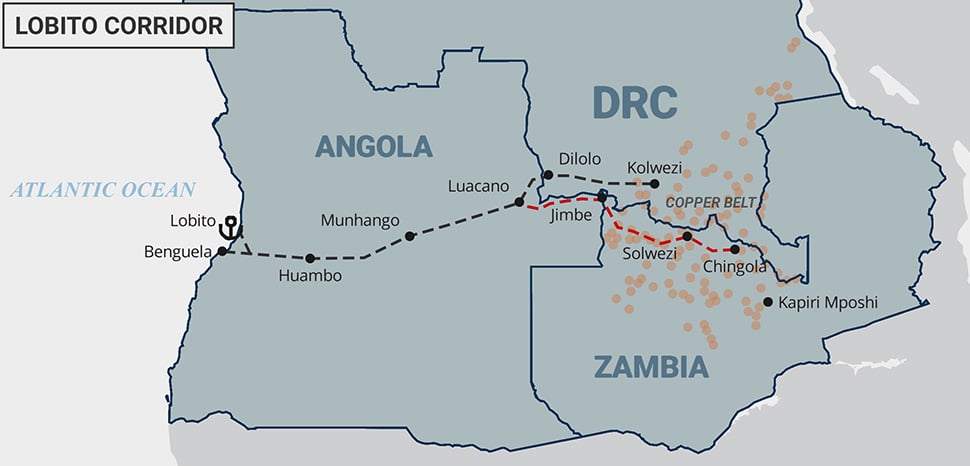
The Lobito Corridor is a rail-based logistics system anchored in the Benguela Railway, connecting the Port of Lobito on Angola’s Atlantic coast to inland production zones linked to the Copperbelt across southern Democratic Republic of the Congo and northern Zambia. Its primary function is to provide an Atlantic export route for bulk freight, most notably copper and cobalt originating from the mineral-rich interior.
Construction of the Benguela Railway began in 1902 as part of an effort to connect coastal infrastructure with inland production areas. For much of the twentieth century, it served as a central mineral export artery before activity declined sharply during Angola’s civil war. Rehabilitation efforts in the early 2000s restored operational continuity, allowing the corridor to re-emerge as a modern logistics route structured around rail–port integration.
Today, rail and logistics operations are managed under a long-term concession by Lobito Atlantic Railway, a consortium bringing together Trafigura, Mota-Engil, and Vecturis. The concession framework covers rail operations between the port and inland freight terminals and coordinates interfaces with regional rail networks serving the Copperbelt.
Why now?
The renewed relevance of the Lobito Corridor is rooted in shifts in global demand for copper and cobalt as inputs into electrification and industrial systems. Projections from the International Energy Agency point to sustained growth in copper demand linked to renewable energy infrastructure and electric vehicle deployment, increasing pressure on the scale and reliability of mineral supply chains.
These dynamics converge on the Central African Copperbelt, spanning southern Democratic Republic of the Congo and northern Zambia, which remains among the most concentrated sources of copper and cobalt globally. As output volumes have expanded, transport capacity has become a binding constraint, with exports concentrated along a limited set of southern and eastern routes. Within this context, the Lobito Corridor offers a westward Atlantic outlet that shortens access to European and American markets, supported by rehabilitated rail infrastructure and a long-term operating concession that stabilise logistics performance.
Engagement by the United States around critical minerals has also become more operational as supply chain resilience gains strategic weight. Cooperation with the Democratic Republic of the Congo and regional partners has increasingly focused on trade-enabling infrastructure rather than policy signalling alone. The USD 553 million loan provided by the U.S. International Development Finance Corporation reflects this shift toward long-horizon financing of export logistics as a component of supply chain strategy.
For regional governments, engagement with the corridor reflects strategic positioning within expanding production systems. For Angola, the corridor consolidates the Port of Lobito as a transit gateway serving mineral flows beyond its national hinterland. For the Democratic Republic of the Congo and Zambia, it introduces an additional Atlantic evacuation route alongside existing corridors as Copperbelt volumes rise. Participation by the Development Bank of Southern Africa aligns with this regional logic, consistent with its mandate to support cross-border infrastructure with economic relevance at scale.
Road ahead
At an economic level, the Lobito Corridor has the potential to function as more than a transit route. Its current phase differs from earlier iterations in that integrated rail–port systems, long-term concession structures, and structured development finance collectively support a level of operational stability that was previously difficult to maintain. This positions the corridor as a durable component of regional economic infrastructure aligned with sustained demand for copper and cobalt.
These dynamics unfold within the Copperbelt, spanning southern Democratic Republic of the Congo and northern Zambia, a region characterised by rapid population growth and a youthful demographic profile. In the DRC, population expansion has been particularly pronounced, driven by strong demographic momentum. Across the Copperbelt, dense urbanisation around mining centres has outpaced the capacity of public systems to absorb labour and deliver housing, education, and basic services, generating persistent gaps between economic activity and social provision.
Viewed in this context, the Lobito Corridor forms part of a broader regional configuration where resource extraction intersects with rising demographic and social pressure. For governments, the strategic question extends beyond transport efficiency to how national development priorities shape the organisation of mineral production, logistics infrastructure, and associated economic activity. Where population growth is rapid and social systems are already under strain, policy choices influence how export-oriented infrastructure translates into employment outcomes and human capital formation over time.
In critical mineral value chains such as copper and cobalt, higher value-added stages remain concentrated beyond extraction and transport, particularly in refining and downstream activities. In economies marked by rapid demographic expansion, access to these segments is closely linked to the strength of social and institutional foundations that support skills formation and workforce integration. Under these conditions, value capture is tied to how expanding populations are positioned to participate in more advanced stages of economic activity.
References
- AfricanPact. (2025, October 2). Africa’s critical minerals: From resources to industrial power. https://africanpact.org/2025/10/02/africas-critical-minerals-from-resources-to-industrial-power/
- AfricanPact. (2025, September 23). Botswana, diamonds, and diversification. https://africanpact.org/2025/09/23/botswana-diamonds-diversification/
- AfricanPact. (2025, November 19). Simandou, Guinea: A megaproject in context. https://africanpact.org/2025/11/19/simandou-guinea-megaproject/
- European Commission. . Lobito Corridor: Building the future together. International Partnerships. https://international-partnerships.ec.europa.eu/lobito-corridor-building-future-together_en
- Freight News. . The Lobito Corridor: An alternative for ore outflows. https://www.freightnews.co.za/article/the-lobito-corridor-an-alternative-for-ore-outflows
- International Development Finance Corporation. . DFC CEO signs loan agreement with Lobito Atlantic Railway. https://www.dfc.gov/media/press-releases/dfc-ceo-ben-black-signs-loan-agreement-lobito-atlantic-railway-securing
- Lobito Atlantic Railway. (2025). Lobito Atlantic Railway secures USD 753 million to accelerate development in Angola. https://www.lobitoatlantic.com/news-resources/news/lobito-atlantic-railway-secures-usd753-million-to-accelerate-development-in-angola/
- Reuters. (2025, December 17). U.S. agency, consortium sign $553 million loan for Angola railway revamp. https://www.reuters.com/world/africa/us-agency-consortium-sign-553-million-loan-angola-railway-revamp-2025-12-17/
- Nanyang Technological University. (n.d.). Reviewing the Lobito Corridor. Centre for African Studies. https://www.ntu.edu.sg/cas/news-events/news/details/reviewing-the-lobito-corridor
- Wikipedia contributors. (n.d.). Lobito Corridor. In Wikipedia. https://en.wikipedia.org/wiki/Lobito_Corridor